





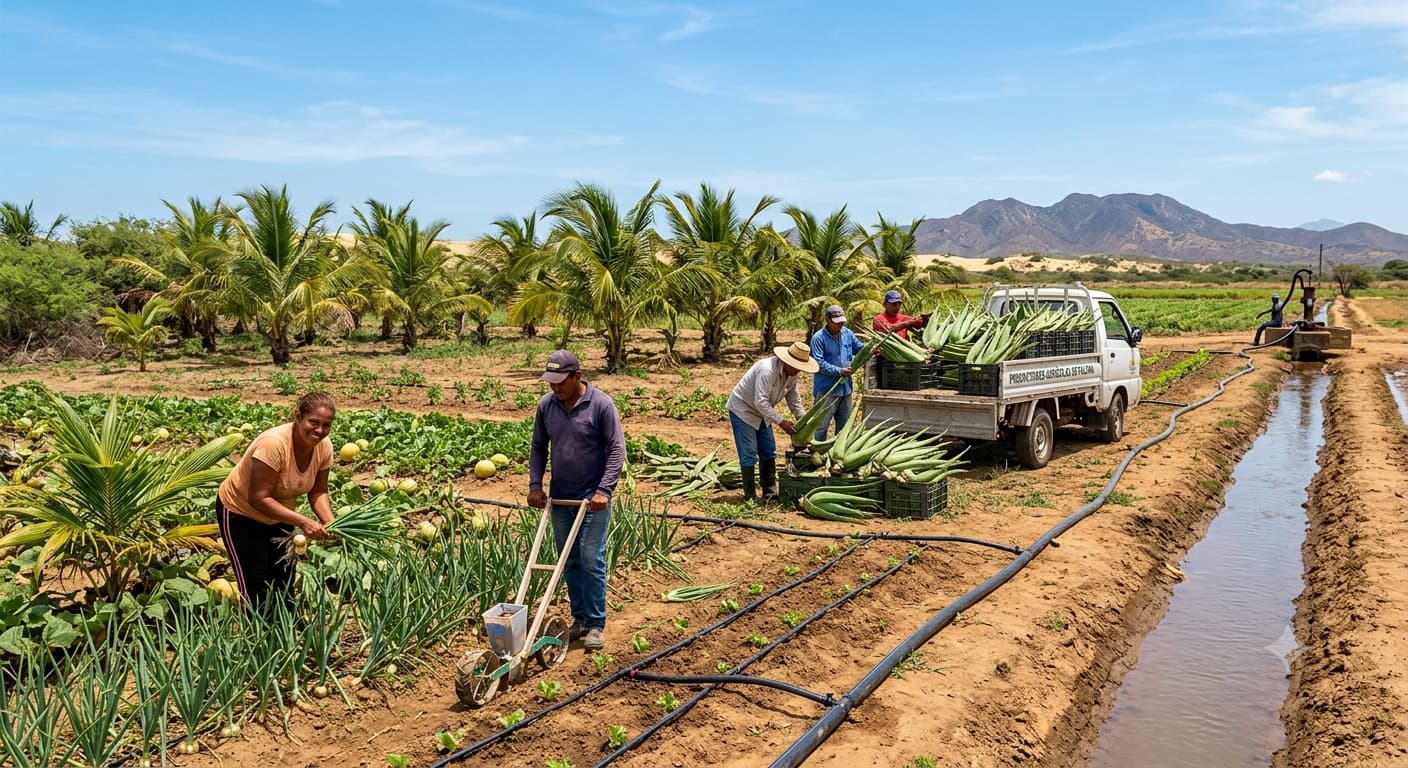
Agricultural mechanization has returned to the center of the official agenda with the presentation of the National Mechanization Program (PRONAMEC), a Ministry of Agriculture strategy to modernize the Dominican countryside and address the labor shortage. Agricultural mechanization seeks to raise productivity, reduce costs, and make national production more competitive.
Agricultural mechanization for a key sector
The Government maintains that agriculture has a decisive weight in the economy: it contributes 5.6% of GDP, generates 8.8% of national employment, and represents 11.8% of exports. In this context, agricultural mechanization appears as one of the three strategic axes of the ministry, along with agricultural extension and agro-food security.
The initiative responds to a well-known reality in the countryside: a large part of the tasks of planting, land preparation, harvesting, and post-harvest depends on foreign workers, many in an irregular migratory status. This dependency has exposed the sector to cost increases, lower personnel availability, and tensions derived from migration changes. Agricultural mechanization is proposed as a gradual way out to reduce that risk.
Agricultural mechanization and small producers
The program also targets the country’s productive structure. Of the nearly 260,000 registered producers, around 81% are small-scale. For that universe, the purchase of modern equipment is often out of reach due to a lack of credit or guarantees. Therefore, PRONAMEC proposes to democratize access to agricultural mechanization with public support and specialized financing.
- Higher productivity per hectare
- Lower post-harvest losses
- More efficient use of water and fertilizers
- Lower cost per worked task
What the agricultural mechanization plan includes
The proposal ranges from soil preparation and leveling to planting, smart irrigation, fertilization, the use of drones, harvesting, sorting, and transportation. The official logic is that agricultural mechanization not only replaces manual labor, but also improves precision and reduces waste.
The plan also contemplates a network of Agricultural Mechanization Service Centers, equipment purchases, technical training, and digital platforms to manage the system. In parallel, the Government is promoting financing schemes with state backing and the participation of the Agricultural Bank, BANDEX, and private banking. This combination would be key for agricultural mechanization to reach more productive regions.
The official goal is to make production more efficient, more profitable, and less vulnerable to the lack of labor.
A shift in agricultural policy
Agricultural mechanization is not a new debate in the Dominican Republic, but it does gain urgency due to pressure on costs, labor migration, and the need to secure food at more stable prices. The challenge will be to turn the announcement into real equipment, accessible financing, and sustained technical assistance so that agricultural mechanization does not remain just on paper.
If the program manages to expand rapidly and without excluding small producers, agricultural mechanization could mark a profound change in the way of producing in the country. In that scenario, agricultural mechanization would be more than a response to the labor shortage: it would be a commitment to the competitiveness of the Dominican countryside.