






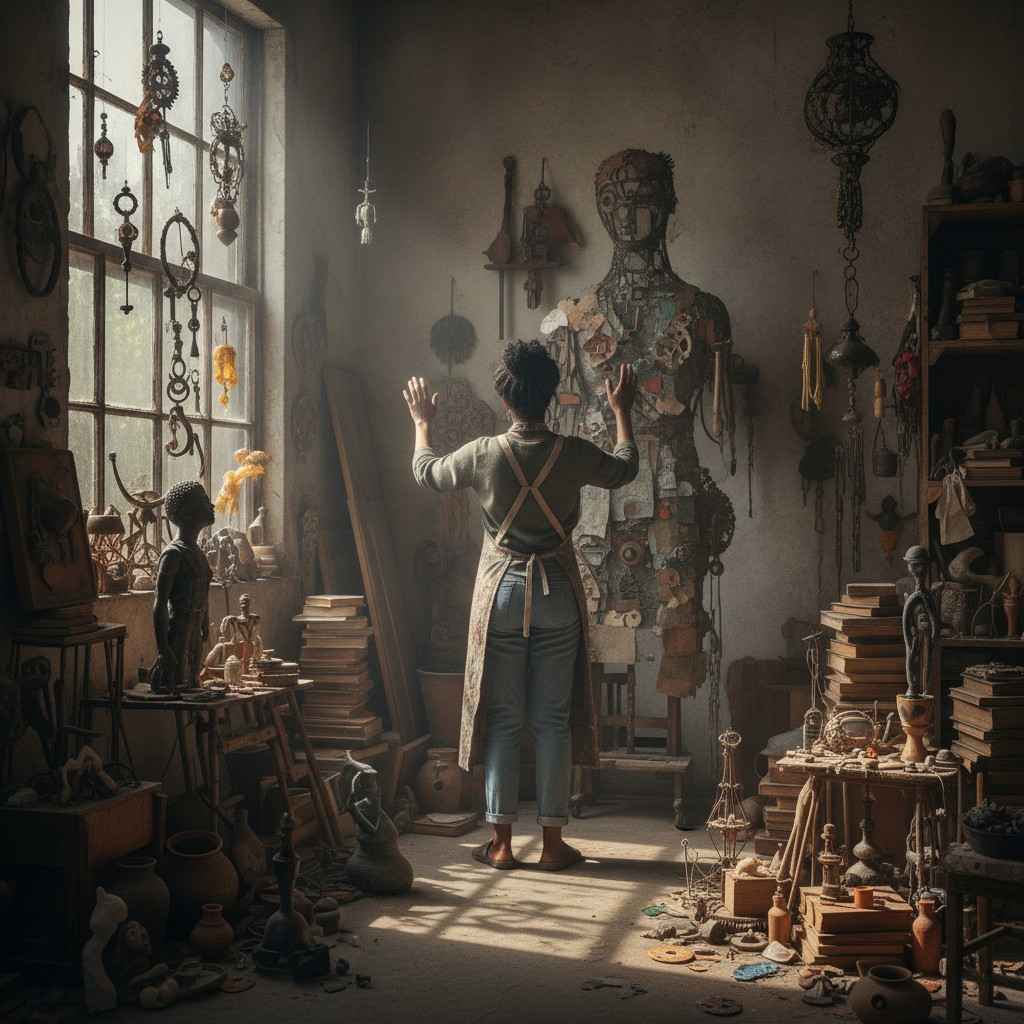
Betye Saar passed away at the age of 99 in Los Angeles, California, and her death brings to a close a decisive career for contemporary African American art in the United States. The artist died just days before reaching her centenary, according to the baseline content of the original news report.
For decades, Betye Saar became a reference for her way of reimagining Black identity, memory, and the female experience within art. Her name became associated with a generation of creators that expanded the boundaries of cultural representation in museums, galleries, and academic spaces.
The relevance of Betye Saar is not explained solely by her artistic longevity, but by the consistency of a body of work that engaged with the racial history of the United States. Her impact was especially visible in the use of assemblages and found objects, a strategy that turned everyday materials into pieces charged with symbolic and political meaning.
In the context of African American art, Betye Saar occupied a benchmark position alongside other foundational names that helped change the conversation on race, memory, and cultural power. Her work made space for new generations of Black artists to find legitimacy and visibility in institutions traditionally dominated by other narratives.
Betye Saar and Los Angeles
Los Angeles was the setting of her death and also one of the most important environments for her creative development. The Californian city has historically been a key center for African American art production, and the presence of Betye Saar there reinforces her bond with a diverse and far-reaching cultural scene.
The news comes at a time when African American art continues to receive greater critical and curatorial attention. In that landscape, Betye Saar remains an essential figure for understanding how art can act as an archive, denunciation, and historical memory.
A body of work that changed the conversation
Beyond the immediate tribute, the death of Betye Saar compels us to look back at her legacy. Her work was part of the expansion of Black voices in American art and contributed to consolidating a distinct visual language with strong social and cultural content.
The figure of Betye Saar leaves an unequaled mark on contemporary African American art.
- Betye Saar died at age 99.
- She passed away in Los Angeles, California.
- She was one of the most influential artists in African American art.
- 她的 legacy remains key to the debate on identity and representation.
With the passing of Betye Saar, art loses a foundational creator whose name will continue to appear in any serious conversation about African American art in the United States. Her influence, visible in museums, critical studies, and new generations, confirms that Betye Saar will remain relevant long after her death.