



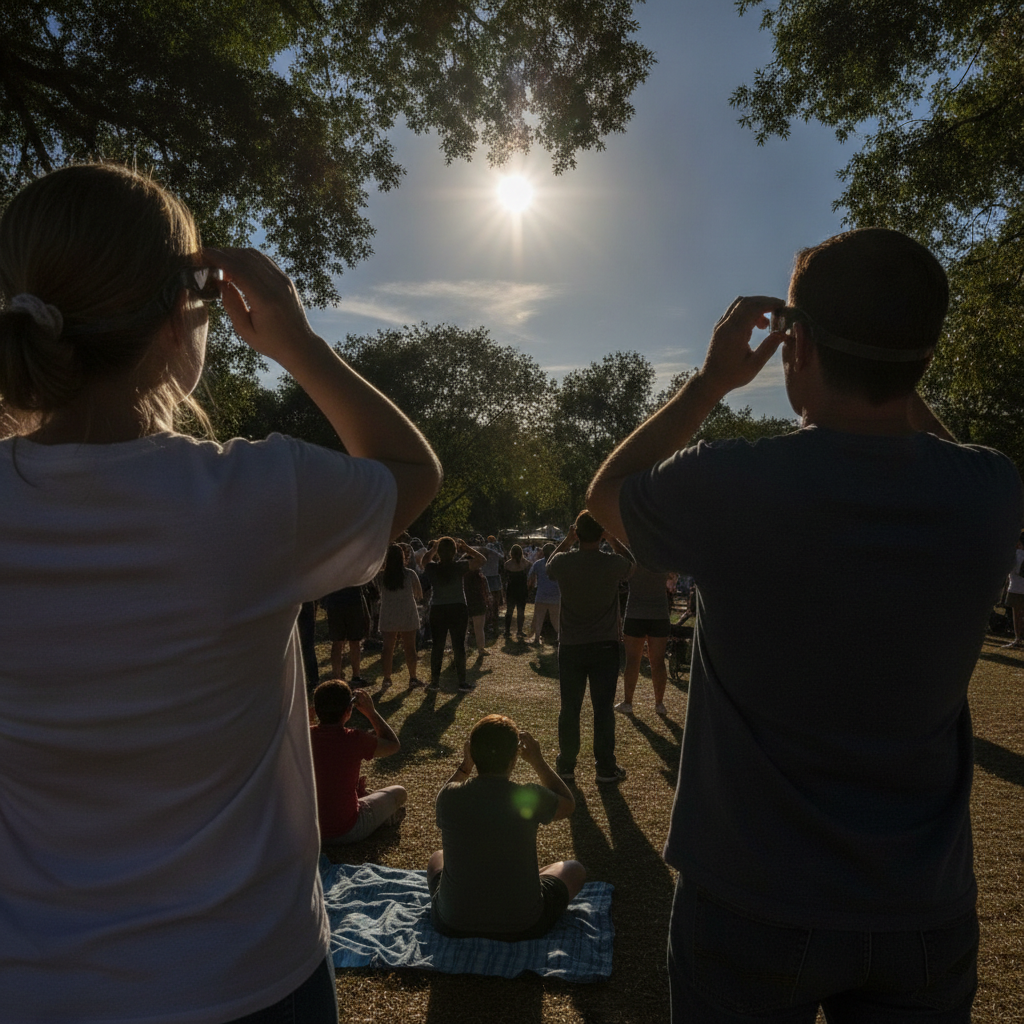
Safe glasses for the eclipse will be the stars of one of the most anticipated astronomical events of the year: the August 12 eclipse. The Spanish Government, through the Ministry of Science, Innovation and Universities, and the ONCE Social Group have announced the free distribution of two million certified eye protection devices to ensure safe observation throughout the territory.
From A Coruña, the EFE agency reported that this initiative will be coordinated by the Secretary of State for Science, Innovation and Universities, Juan Cruz Cigudosa, along with the First Vice President of Institutional Coordination, Solidarity and External Relations of the General Council of the ONCE. Both organizations aim to ensure that no citizen observes the phenomenon without safe glasses for the eclipse, reducing the risk of irreversible damage to the retina.
The glasses will be distributed mainly through the ONCE network, educational centers, scientific associations, and selected public spaces. These are devices that meet international standards for protection against intense solar radiation, designed specifically for eclipses, very different from conventional sunglasses.
Why safe glasses for the eclipse are essential
Experts in ophthalmology recall that direct observation of the Sun, even during a partial or total eclipse, can cause burns in the retina and permanent loss of vision. Organizations such as European astronomical societies insist on the use of safe glasses for the eclipse certified with ISO 12312-2 filter, capable of blocking most of the damaging radiation.
The Ministry of Science has linked this campaign to scientific dissemination, promoting educational activities and talks to explain the astronomical phenomenon, its phases, and the correct way to observe it. The integration of the ONCE Social Group is key, as its experience in accessibility and visual disability allows it to design a strategy focused on protecting the most vulnerable groups.
Mass distribution and scientific advice
The operation to deliver safe glasses for the eclipse combines social logistics and technical advice. The ONCE will take advantage of its presence in streets and municipalities to bring the material to the general population, while the Ministry coordinates with universities and research centers the validation of the filters used in the glasses.
According to data from previous eclipses visible in Europe, cases of eye injuries have been registered due to the use of makeshift methods, such as smoked glass, radiographs, or un-certified lenses. This campaign aims to avoid the repetition of these errors and highlight the difference between safe devices and improvised solutions.
Impact of the educational and technological phenomenon
The August 12 eclipse also sees an opportunity to promote scientific vocations in areas such as astronomy, physics, and optical technology. Educational centers are preparing supervised observation activities, always based on safe glasses for the eclipse and indirect projection devices.
In addition, the use of these glasses is linked to campaigns to raise awareness about eye care and the importance of consulting an ophthalmologist in case of any symptoms after observing the event, such as blurred vision or dark spots.
Recommendations for using safe glasses for the eclipse
- Check that the safe glasses for the eclipse are intact, without scratches or perforations.
- Use them during the entire time you look at the Sun, without removing them while directing your gaze at the star.
- Do not combine the glasses with binoculars, cameras, or telescopes if these do not have solar filters specifically.
- Keep children and older adults supervised during the observation.
With the free distribution of two million safe glasses for the eclipse, the Government and the ONCE aim to ensure that citizens enjoy the astronomical spectacle with safety, awareness, and scientific accompaniment, turning August 12 into a responsible and accessible observation day for all.