









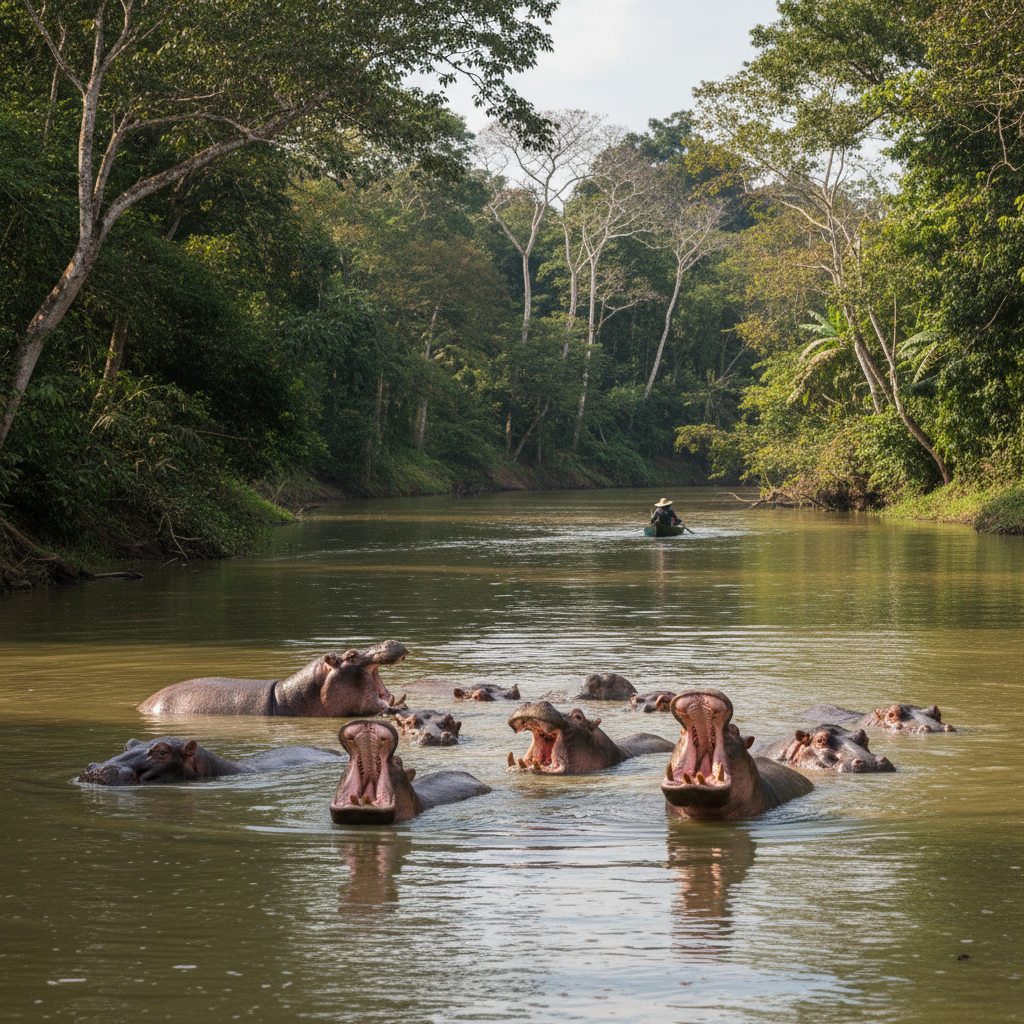
The Colombian government advances with a controversial plan to sacrifice hippos, declared an invasive species. Introduced in the 80s by the narco-trafficker Pablo Escobar in his Hacienda Nápoles, these animals have proliferated to nearly 200 individuals, threatening the biodiversity of the Magdalena River and local communities.
Origin and expansion of the problem
Escobar imported four hippos –a male and three females– for his private zoo. After his death in 1993, the animals escaped and reproduced without natural predators. Experts from the Humboldt Institute project that their population could surpass 500 by 2030 and reach 1,000 by 2035, altering aquatic ecosystems and competing with native fauna.
Debate between science, animalism and ethics
The Ministry of Environment, led by Minister Irene Vélez, announced the euthanasia of at least 80 individuals in the first semester of 2026. The measure responds to scientific evidence highlighting risks such as river contamination by their feces and attacks on humans. Protocols include shots by certified shooters and biosecurity in final disposal.
Confronted positions
- Scientists and authorities: Support sacrificing hippos to avoid a greater ecological disaster. Germán Jiménez, from the Javeriana University, emphasizes their high reproduction rate.
- Animalists: Senator Esmeralda Hernández criticizes the decision for its ethical implications, questioning whether Colombia should kill animals due to previous human failures.
Since 2022, hippos are an officially invasive species, enabling strict controls. Attempts at re-location failed due to lack of receivers and high costs, leaving euthanasia as the main option.
This clash reveals tensions between environmental conservation and animal rights. Researchers warn that without intervention, the impact would be uncontrollable. The plan combines limited relocations with sacrificing hippos, prioritizing the protection of native wildlife and community well-being.
Ultimately, sacrificing hippos in Colombia puts to the test the balance between science, animalism and ethics in managing invasive species.