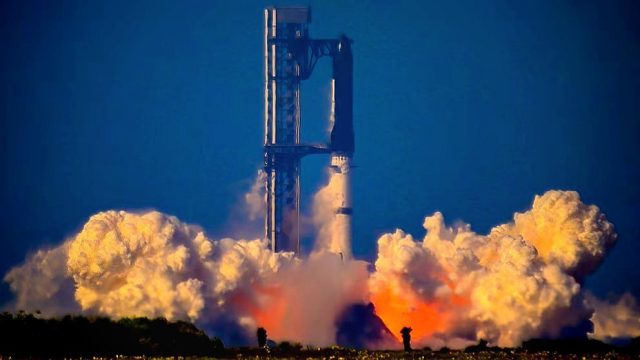










Russia launches the Soyuz MS-29 spacecraft with three crew members on board heading to the International Space Station, in a new milestone for international cooperation in space. From the Baikonur Cosmodrome in the Kazakh steppe, the liftoff took place at the scheduled time, marking another step in the continuity of crewed missions to low Earth orbit.
The launch was carried out on a Soyuz-2.1a carrier rocket, a platform that has become Russia’s standard system for crewed missions to the International Space Station. According to official data, the liftoff occurred at around 14:48 GMT, meeting the planned launch window and the safety conditions required for this type of orbital operation.
On board the Soyuz MS-29 are two Russian cosmonauts and one American astronaut. Space sector sources note that the crew is composed of cosmonauts Pyotr Dubrov and Anna Kikina, along with NASA astronaut Anil Menon, for whom this flight marks his first mission to space. This combination of crew members confirms the international nature of the ISS and the validity of cross-transport agreements between Roscosmos and NASA.
Trajectory towards the International Space Station
Following the moment when Russia launches the Soyuz MS-29 spacecraft, the capsule initiates a series of automated orbital maneuvers to rendezvous with the International Space Station. The flight profile typically takes between six and eight hours from liftoff to docking, although the Russian program has tested ultra-fast ascent profiles of approximately three hours in other missions.
The ISS orbits Earth at an altitude of about 400 kilometers and travels at a speed close to 28,000 kilometers per hour. Any launch, including this one in which Russia launches the Soyuz MS-29 spacecraft, is calculated with precision to coincide with the station’s passage over the Baikonur Cosmodrome, optimizing fuel and reducing risks during the approach maneuvers.
A new chapter in the history of Soyuz
The Soyuz program is one of the longest-running in space exploration. Its first version flew in the 1960s and, since then, it has been upgraded multiple times. The MS series, to which the Soyuz MS-29 belongs, incorporates improvements in navigation, communication, and safety systems, maintaining a reliability statistic considered one of the highest in the sector.
When Russia launches the Soyuz MS-29 spacecraft, it not only transports a new crew, but also reaffirms the role of these spacecraft as the backbone of human access to orbit. For years, Soyuz capsules were the only crewed means of transport to the ISS, especially after the retirement of the U.S. space shuttles in 2011.
Cooperation and mission objectives
In addition to the crew rotation for ISS Expeditions 74 and 75, the mission in which Russia launches the Soyuz MS-29 spacecraft includes the delivery of scientific experiments, maintenance equipment, and personal supplies for the astronauts living on the station. Joint programs between Roscosmos, NASA, and other agencies allow for the study of the impact of prolonged stays in microgravity and the testing of key technologies for future missions to the Moon and Mars.
Space flight experts emphasize that every time Russia launches the Soyuz MS-29 spacecraft or a similar mission, humanity’s ability to sustain a continuous presence in space is strengthened. For countries like the Dominican Republic and the Latin American region, this type of mission serves as a reference for the development of scientific and educational policies focused on aerospace technology and Earth observation.
Technological impact and future projection
The use of the Soyuz-2.1a rocket and the Soyuz MS-29 capsule demonstrates Russia’s commitment to reusable systems in terms of launch infrastructure and continuous reliability testing. Analysts note that the experience accumulated at Baikonur, where Russia launches the Soyuz MS-29 spacecraft and other missions regularly, constitutes a strategic asset for the country in the competitive space services market.
In this context, the fact that Russia launches the Soyuz MS-29 spacecraft toward the International Space Station reinforces the relevance of global cooperation in science and technology, a key aspect for new generations who view space not only as a symbol of power, but as an innovation laboratory with a direct impact on daily life.