









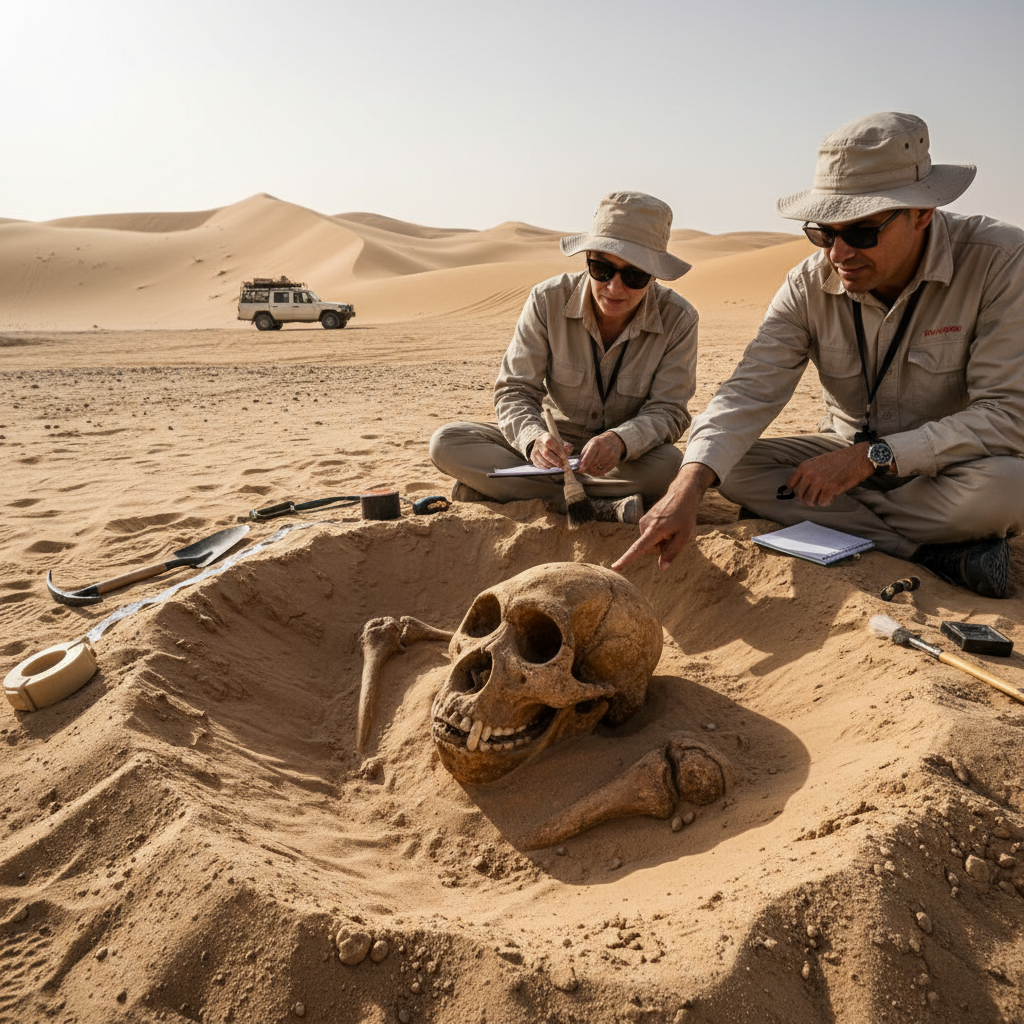
In the sands of the Egyptian desert, an international team of researchers has unearthed a fossil of a new species of ape that promises to alter the books of evolutionary history. Named Masripithecus moghraensis, this discovery consists of jaw remains dated to the Early Miocene, about 17 to 18 million years ago. It is the first fossil of a new species of ape found in North Africa, a region previously considered lacking such evidence.
Context of the Miocene discovery
For decades, the fossil record of the Early Miocene in North Africa was limited to fragmentary remains of other primates. This new species of ape fills a crucial gap. Scientists, led by experts from the University of Toronto and the Max Planck Institute, analyzed the jaw at the Moghra site in the Bahariya Formation. Its dental features, such as robust molars adapted to varied diets, suggest connections with Asian and European lineages, challenging the idea of an exclusively eastern origin for hominoids.
Evolutionary implications of Masripithecus moghraensis
Expert opinions on evolution
‘This fossil rewrites the map of ape dispersal. It indicates early migrations from Asia into Africa via land corridors now submerged,’ says lead paleontologist Alan Turner in recent statements.
The Masripithecus moghraensis measures barely 10 centimeters in length, but its skeletal structure points to an animal the size of a modern gibbon, with adaptations for climbing. Comparative studies with fossils from Turkey and Pakistan reveal similarities in dental morphology, supporting theories of multiple migratory waves during the Miocene.
Background and verified data
- Precise age: 17.5 million years, confirmed by radiometric dating.
- Location: Bahariya Formation, rich in Miocene mammals.
- Significance: First North African ape, bridge between Africa and Eurasia.
Experts such as Laura MacLatchy of the University of Colorado note that this find challenges previous models. Previously, it was thought that modern apes originated in East Africa about 15 million years ago. Now, the new species of ape suggests a pioneering role for North Africa. Complementary investigations at nearby sites are seeking more remains to reconstruct its complete skeleton.
This advancement not only enriches the evolutionary puzzle, but also highlights the importance of excavations in underexplored regions. The fossil of a new species of ape in Egypt redefines the origin of modern apes, inviting new expeditions on the continent.