







National Visual Arts Award: Oscar Abreu criticized the interruption of this recognition and warned that a country that stops honoring its artists also weakens its cultural memory.
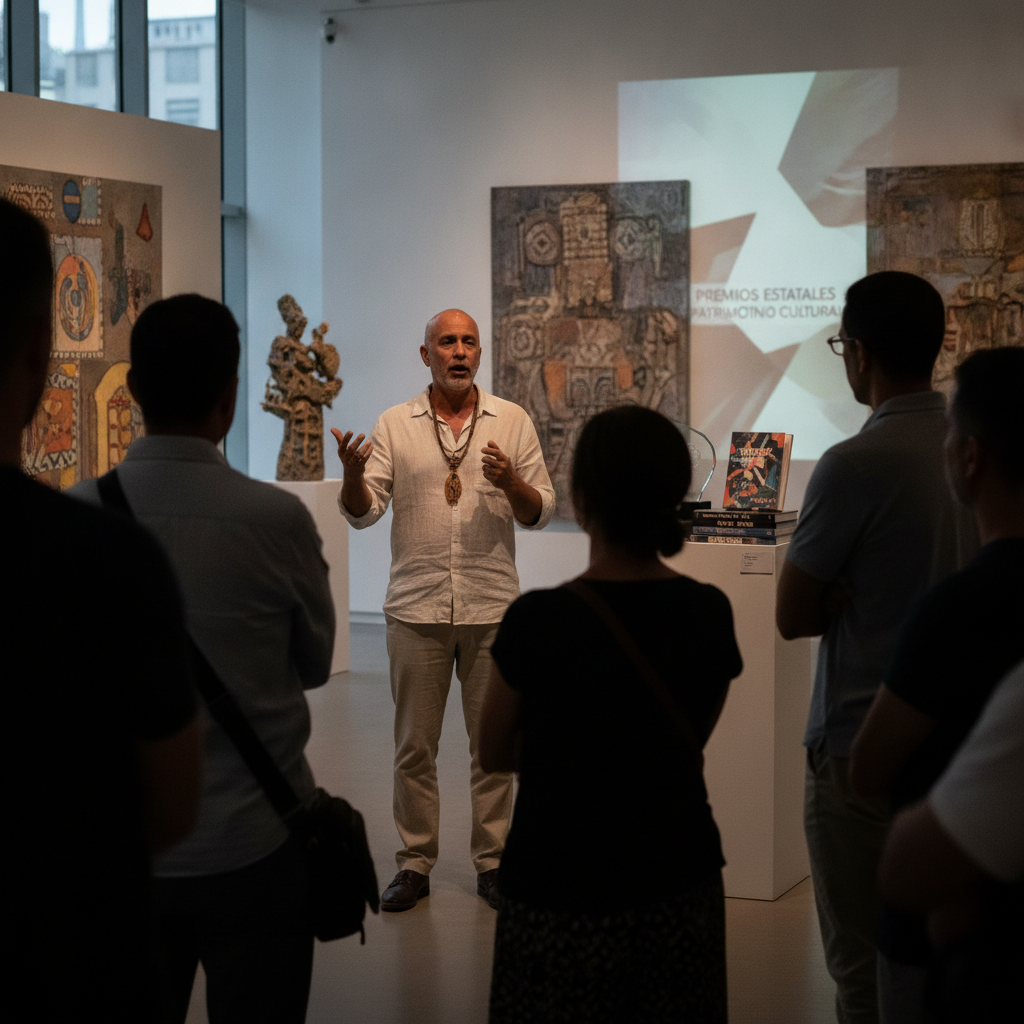
The statement was made during a meeting with the press at the Museo Abreu, in Punta Cana, where the visual artist, founder of that institution and creator of Psico-Expresionismo, expressed concern over the lack of continuity in an award considered the highest state recognition for the visual arts in the Dominican Republic. The National Visual Arts Award usually functions, in addition to being an incentive, as a public signal of institutional appreciation toward consolidated careers.
Abreu’s criticism focuses on the symbolic impact of the suspension or delay of an award of this type. In the cultural field, the continuity of official awards helps organize the artistic calendar, give visibility to careers, and reinforce the legitimacy of the institutions in charge of promoting creation.
In various countries in the region, state visual arts awards maintain regular calls for entries and differentiated amounts for works and lifetime achievements, which reflects a sustained recognition policy. This contrast makes the concern of artists who understand the National Visual Arts Award as part of the cultural infrastructure, rather than just a ceremonial act, much more visible.
What is at stake for artists
When a recognition is interrupted, the effect is not limited to an administrative vacuum. It can also affect the public projection of creators, the archive of artistic memory, and the perception of which values the State prioritizes. Within this framework, Abreu’s warning points to a concrete idea: without awards, without archives, and without continuity, the cultural narrative becomes more fragile.
National Visual Arts Award also means legitimation. For many artists, being featured in an official selection opens doors to exhibitions, institutional purchases, and greater circulation of work.
The symbolic value of the National Visual Arts Award
Abreu’s statement was direct: a country that stops honoring its artists begins to forget its history. Beyond the phrase itself, the core of the demand is well known to managers and creators: culture needs consistent policies so as not to depend on political circumstances.
- The National Visual Arts Award recognizes outstanding careers and works.
- Its interruption weakens the visibility of the sector.
- Institutional continuity strengthens cultural memory.
In this context, Oscar Abreu’s voice reopens an ongoing discussion about the place the National Visual Arts Award occupies on the public agenda and about the country’s real commitment to its artists. For the creator, the issue is not just a matter of protocol: it is a question of identity, memory, and respect for cultural work.