







A scientific discovery at the bottom of the whale cemetery in the Indian Ocean is revealing how life can flourish in one of the most extreme environments on the planet, almost 7 kilometers deep.
An ancient whale cemetery that is full of life
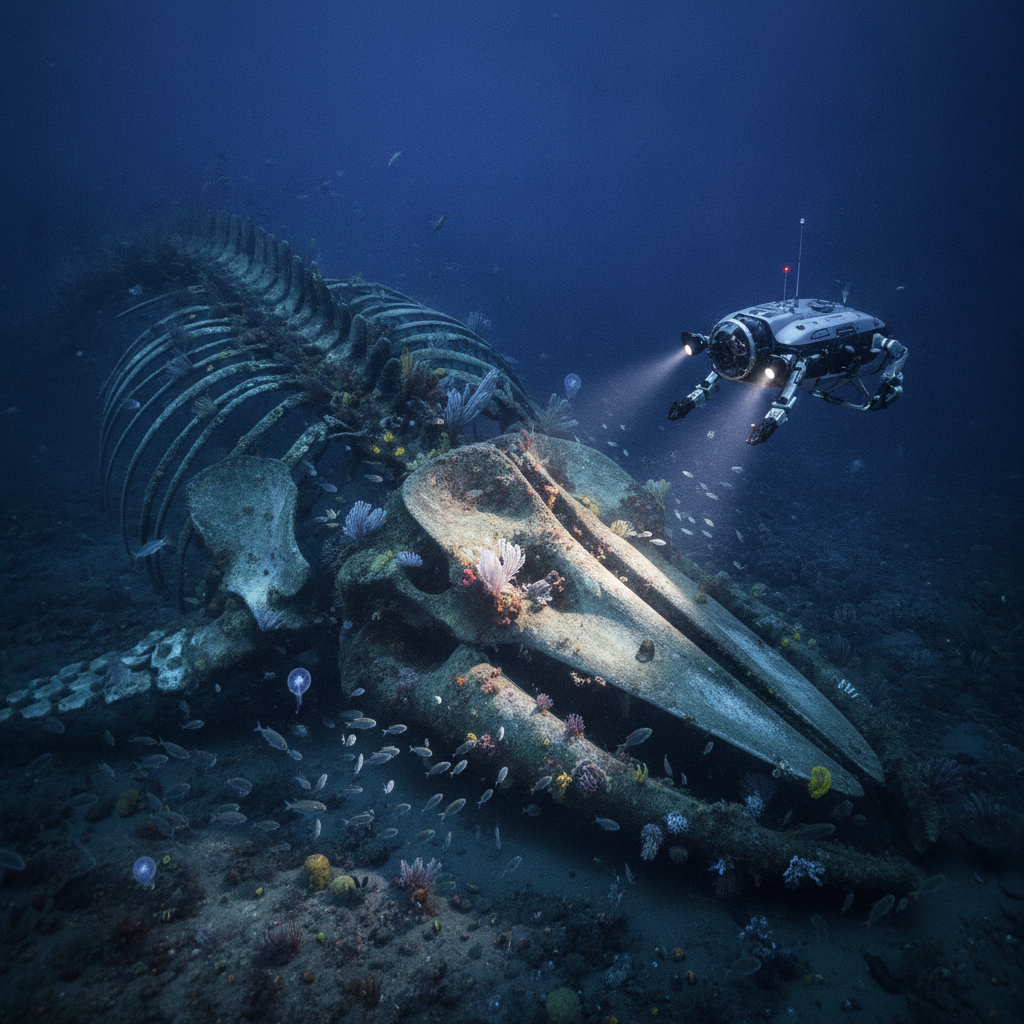
The finding focuses on an ancient whale cemetery formed by the remains of these large marine mammals that, after dying, sank slowly to the ocean floor. There, their skeletons have created, over millions of years, an oasis of nutrients in the middle of a submarine desert. In that bony structure now thrive jellyfish, tube worms, ophiuroids, and a variety of invertebrates that take advantage of every fragment of organic matter.
Scientists explain that these so-called “whale falls” can support complete communities for decades. First, scavengers arrive that consume the flesh, then specialized bacteria appear, and on that base, a complex ecological network is installed that converts the whale cemetery into a kind of island of life in total darkness.
Cutting-edge technology to explore the deep Indian Ocean
The discovery was possible thanks to the use of remotely operated vehicles (ROV) and submersibles equipped with high-definition cameras, chemical sensors, and robotic arms capable of taking samples without destroying the fragile environment. These platforms allow for precise mapping of the whale cemetery and detailed documentation of the associated biodiversity.
Deep-sea ecosystem specialists point out that each new site of this type found in the Indian Ocean offers clues about the evolution of species adapted to the lack of light, extreme pressure, and scarcity of food. It also provides key information to understand how carbon is recycled in the ocean and how these processes affect the global climate.
How a whale cemetery forms
When a whale dies, its body can remain floating for a time and then, losing buoyancy, sinks slowly. Once on the bottom, the carcass becomes the center of a whale cemetery, where different ecological phases succeed: from the arrival of sharks and fish scavengers, to the appearance of worms that degrade the bone and release compounds that feed other forms of life.
- Scavenger phase: rapid consumption of soft tissues.
- Enrichment phase: sediments loaded with organic matter.
- Sulfophilic phase: organisms that use sulfur compounds from the bone.
In the Indian Ocean, these phases occur at great depth, making the whale cemetery even more relevant for the study of biological resistance.
Scientific implications and conservation challenges
Researchers consulted emphasize that these findings reinforce the idea that deep-sea biodiversity is underestimated. Each whale cemetery identified opens the door to new potentially unknown species and biological compounds with possible medical or biotechnological applications.
At the same time, they warn that deep-sea fishing, submarine mining, and increased ocean noise could alter these ecosystems before they are fully understood. They propose that areas where these ancient cemeteries are located in the Indian Ocean and other seas be considered for international protection schemes.
A natural laboratory at the bottom of the sea
For the scientific community, this whale cemetery functions as a natural laboratory where life colonizes a limited resource and exploits it to the maximum. Researchers will continue to monitor the site with new missions and 3D digital models to evaluate long-term changes and better understand the role of these enclaves in the dynamics of deep oceans.
As studies expand in the Indian Ocean, interest in each new whale cemetery grows among research teams, environmental managers, and the general public, who see in these findings a sample of how far life can adapt to the most extreme corners of the planet.