









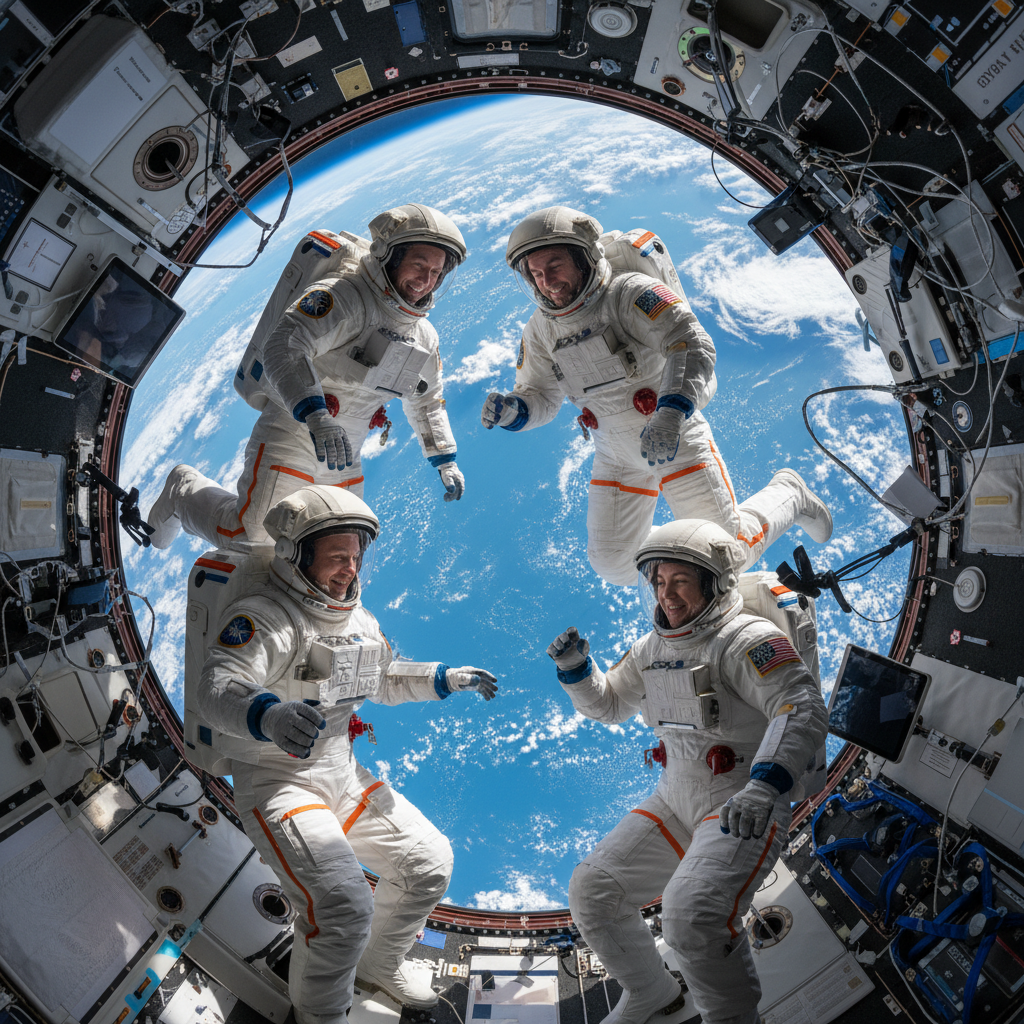
The NASA administrator, Jared Isaacman, confirmed that the Artemis II astronauts are “doing well” while completing their orbit around the Earth. This initial step is crucial in deciding whether to proceed to the Moon or abort the mission. The Orion spacecraft maintains a stable elliptical orbit, with the Mission Control team at the Johnson Space Center in Houston, overseeing every detail.
First day in space after launch
The Artemis II astronauts launched on Wednesday from Cape Canaveral, Florida. During their first day, they dedicated themselves to exhaustive tests to validate the translunar propulsion, which will propel them out of Earth orbit in a four-day journey to the satellite. The team on the ground woke them up with the song ‘Sleepyhead’ by Young & Sick, at 7:06 AM Eastern Time in the US, after a brief post-launch rest.
Key evaluation for the Artemis II astronauts
This Thursday, the mission management team holds their first meeting to review the spacecraft systems and approve the translunar maneuver. If approved, the Artemis II astronauts will arrive on the far side of the Moon on Monday, April 6, reaching over 400,000 kilometers, the farthest point for humans. The crew includes Commander Reid Wiseman, Specialist Christina Koch, Pilot Victor Glover — all from NASA — and Jeremy Hansen from the Canadian Space Agency.
Context of the Artemis program
Artemis II marks the first crewed flight of Orion since Apollo 17 in 1972, reviving lunar ambitions. The program aims to establish a permanent presence on the Moon to prepare for Mars missions, with launches planned for 2027 and 2028, including human landings. Isaacman noted: “The Artemis II astronauts are doing great.” In Cape Canaveral, teams are preparing platforms for frequent launches to the Moon.
This mission not only tests technology but also lays the groundwork for deep exploration, integrating international allies like Canada.
Historically, Artemis corrects lessons from Apollo, incorporating sustainability with the Gateway station. NASA statistics indicate that Orion withstands extreme temperatures and radiation, surpassing previous limits. The Artemis II astronauts represent a milestone in global collaboration, with Hansen as the first Canadian in deep space. In Dominican Pride, we follow these advances that inspire the diaspora and the region.