

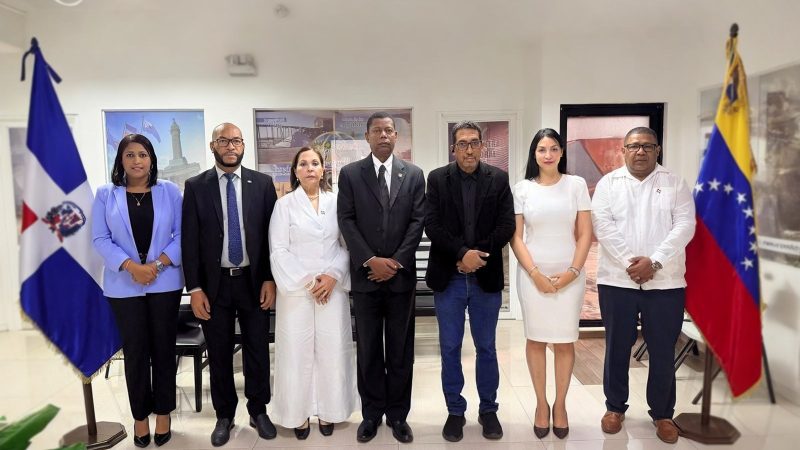

11th Meeting of Public Food Supply Systems kicked off in the Dominican Republic with the presence of President Luis Abinader, in a regional meeting focused on supply, commercialization, and food security.
The event, organized by INESPRE with the support of the FAO and the governments of the Dominican Republic and Brazil, will last for four days and will bring together delegations from 15 countries in Latin America and the Caribbean.
During the opening, the Dominican Government presented progress related to the Zero Hunger goal, an objective that the FAO recognizes as part of the food security policies promoted in the country. Abinader maintained that this achievement is the result of the joint work of several institutions, with an emphasis on the role of INESPRE and national producers.
The president stated that the 11th Meeting of Public Food Supply Systems should not be seen as a conclusion, but rather as a phase of vigilance in the face of economic crises, climatic phenomena, and distortions in international markets.
“This is not an arrival point, this is a new starting point,” said the president when referring to the challenge of sustaining progress in nutrition.
11th Meeting of Public Food Supply Systems under regional pressure
The FAO representative in the country, Rodrigo Castañeda, warned that the region faces uncertainty due to the climate crisis, logistical disruptions, geopolitical tensions, and persistent food inflation. In this context, he defended public supply systems as a state policy, not as an auxiliary measure.
As he explained, these mechanisms help correct market failures, reduce price volatility, and support family farming through public procurement. This vision dominated much of the 11th Meeting of Public Food Supply Systems, where attending countries will seek common strategies to sustain the food supply.
Brazil, the region, and the debate on public procurement
Representatives from Brazil highlighted the need for the regional network to function as a permanent space for cooperation. From CONAB, Arnoldo Campos maintained that public supply systems are increasingly relevant in the face of global uncertainty and crises hitting food production and distribution.
Agriculture Minister Francisco Oliverio Espaillat reaffirmed the Government’s support for national production, while David Herrera Díaz, director of INESPRE, insisted that the 11th Meeting of Public Food Supply Systems will serve to exchange experiences and combat inflation, hunger, and risks to food security.
- Delegations from Brazil, Bolivia, Chile, Colombia, Costa Rica, Cuba, El Salvador, Guatemala, Honduras, Mexico, Panama, Paraguay, Peru, Uruguay, and the Dominican Republic are participating.
- The objective is to review public policies, best practices, and innovative strategies to stabilize prices.
- It also seeks to strengthen access to food in urban and peri-urban areas.
The 11th Meeting of Public Food Supply Systems will take place from August 11 to 14, with the challenge of transforming technical exchange into concrete measures to protect consumers and producers in the region.