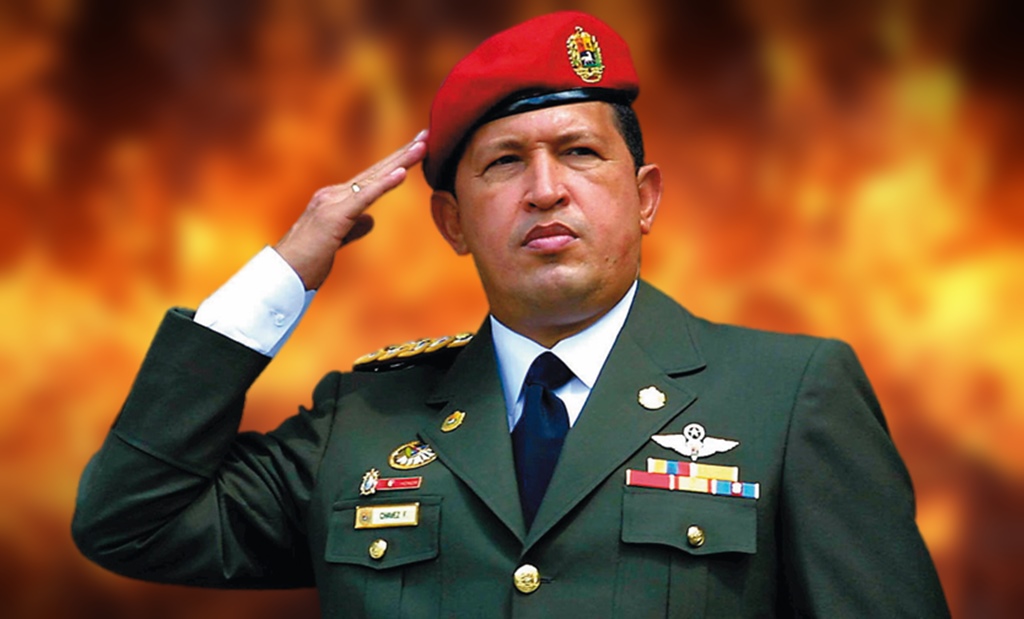
Chávez, as he is mostly known in many Latin American countries, was a Venezuelan military officer and politician. Hugo R. Chávez F. was born in Sabaneta – Barinas, Venezuela, on July 28, 1954.
His death on March 5, 2013, in Caracas due to cancer, shocked many around the world, as he was particularly well-known for his political work and controversies.

Family life, youth and education
Hugo de los Reyes Chávez and Elena Frías, both primary school teachers, were the president’s parents, he being the second of the marriage’s 6 siblings. As a child, he was raised by his paternal grandmother Rosa Inés Chávez, with whom he enjoyed a normal life in the Venezuelan plains.
As a hobby, Chávez himself was a lover of baseball, which he was able to practice later on. Likewise, it is known that he was also an altar boy, and had a certain special fondness for poetry, music, painting, theater, and creative writing.

Academically, in 1966 his school was the Julián Pino School Group, and for his high school education, he attended the Daniel Florentino O’Leary High School, both in Barinas, obtaining his high school diploma with a major in Sciences by the year 1971.
After obtaining his high school diploma, the then-young Chávez had another direction in mind, which was to enter the Military Academy of Venezuela, later graduating with a Bachelor’s Degree in Military Sciences and Arts, with a specialty in Land Engineering. Thus paving the way for him to continue exploring and diversifying in these areas with a military inclination.
Chávez: From military man to politics
If Hugo Chávez had one thing set in his mind, it was that his life would take a political turn that would lead him to the presidency of his country, Venezuela.
First, he founded the Revolutionary Bolivarian Movement 200 (MBR 200). Following this, he later founded and led the Fifth Republic Movement, which was born on October 21, 1997, later becoming the most-voted party in the country from 1998 until 2007; then, it was dissolved to join what is still known as the PSUV, United Socialist Party of Venezuela.
Since then, by the year 1999, a stage began in Venezuela led by the so-called Bolivarian Revolution, which, to date in 2024, is still standing despite many political problems in the country.
Coup against the Venezuelan state in February of ’92
On the night of February 4, 1992, at exactly 11:00 PM, what would be the beginning of a coup d’état on Venezuelan soil began, operating simultaneously in Maracaibo, Caracas, Valencia, and Maracay.

Specifically, in the country’s capital, Caracas, Hugo Chávez was taking the Military History Museum as his base, all while the national force was taking over the media outlet Venezolana de Televisión. Accompanying this deployment, another group was directly confronting the National Guard of Venezuela at La Casona, and finally, a group sought to immediately seize the Miraflores Palace.
The outcome of this act of arbitrary possession led by Commander Hugo Chávez Frías did not yield the results they expected, thus postponing the takeover and sending the president to prison along with the main leaders of the rebellion.
A leap from military man to president of the Republic of Venezuela
After being imprisoned, on March 27, 1994, Chávez was released, achieved following the stay of proceedings granted by Caldera. After this, President Rafael Caldera granted Hugo Chávez an official pardon, rubbing shoulders with other presidents on his trip to Cuba and returning with a long-term strategic project, which between the years 1995 and 1997 began with a presidential campaign effort, leading him to parliamentary elections and resulting in him being the winner of the contest on February 2, 1999.