



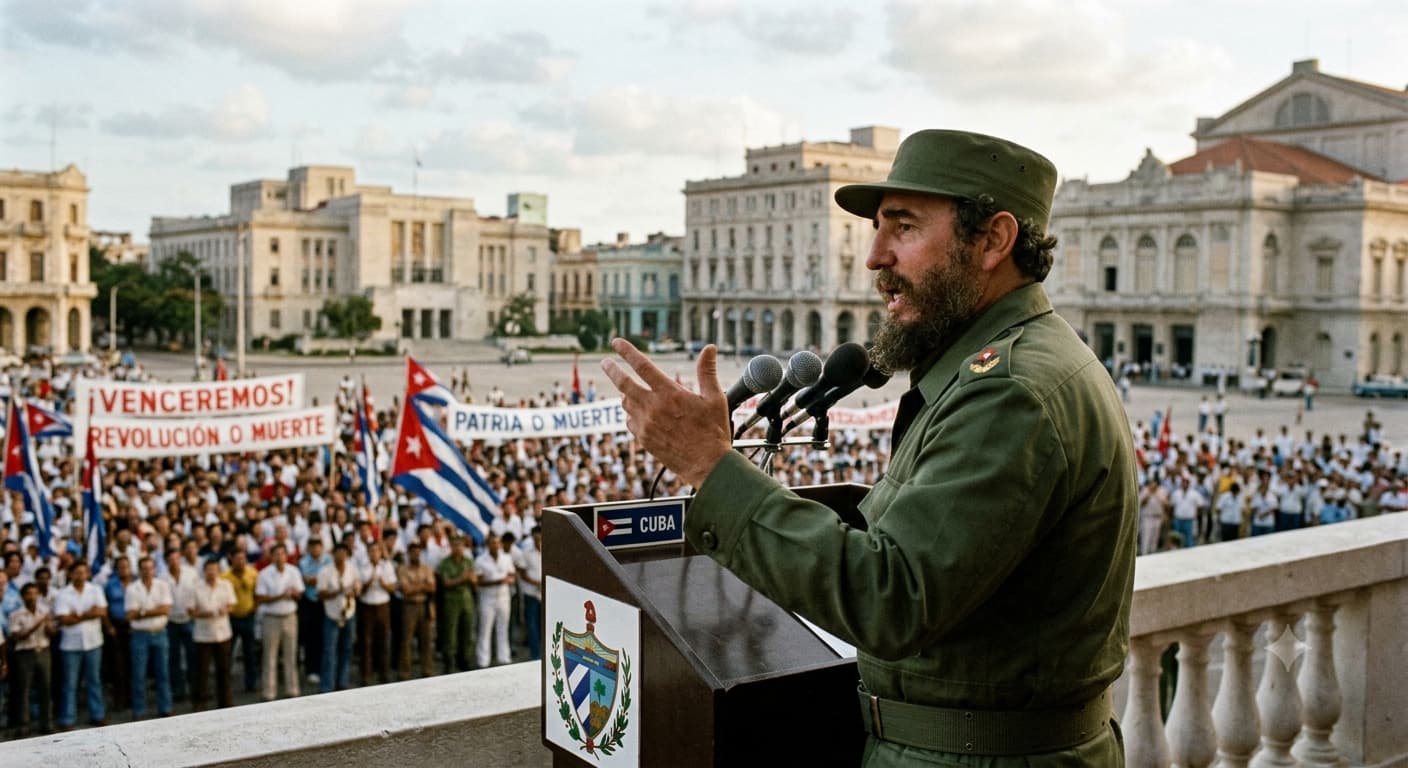
Fidel Castro’s legacy returned to the center of regional political debate after the Broad Front’s statement, which described the centenary of his birth as an occasion to review his influence in Latin America and the Caribbean. The organization maintained that Fidel Castro’s legacy remains present in discussions on sovereignty, social justice and self-determination.
The remark coincides with a series of tributes for the 100 years of his birth, celebrated on August 13, 1926. Fidel Castro died in 2016 and governed Cuba first as prime minister and then as president, after the revolutionary triumph of 1959, according to the historical overview available on his career.
The Broad Front stated that Fidel Castro’s legacy transcends Cuba and left a mark on the continent’s political processes. In its message, it highlighted his confrontation with colonialism, imperialism and external forms of domination that shaped Latin American history in the 20th century.
The organization also underscored Cuba’s internationalist dimension, especially in health, education and cooperation with other countries. This idea has been defended by media and organizations aligned with Havana, which point to sustained social advances even under the United States economic embargo, in place for more than six decades.
Fidel Castro’s Legacy and Historical Debate
Fidel Castro’s legacy does not generate a single reading. For its supporters, it represents resistance, dignity and defense of sovereignty; for its critics, it also carries political tensions, restrictions on freedoms and a strong centralization of power. This dispute explains why his figure continues to be a mandatory reference in regional politics.
“Fidel already belongs to the history of Latin America and the Caribbean,” the organization said when assessing his impact beyond Cuba.
Youth, Cuba and Political Memory
The Broad Front urged new generations to study Fidel’s thought and not stop at the slogan. In its view, Fidel Castro’s legacy should be read within the historical context of his era, as a key experience to understand current debates on independence, cooperation and development.
The group also expressed solidarity with the Cuban people and defended their right to decide their development model without external pressure. In this context, it reiterated its rejection of the U.S. embargo, which it considers a direct obstacle to the economy and everyday life on the island.
Fidel Castro’s Legacy in the Dominican-Cuban Relationship
From the Dominican Republic, the Broad Front linked Fidel Castro’s legacy with the sovereignist traditions of figures such as Duarte, Luperón, Manolo Tavárez Justo and Caamaño. With this angle, it sought to frame the discussion within a regional vision of independence, peace and self-determination.
The organization closed its message insisting that Fidel Castro’s legacy should serve to strengthen the brotherhood between the Dominican and Cuban peoples, at a time when debates on national sovereignty, cooperation and social justice remain ongoing.