





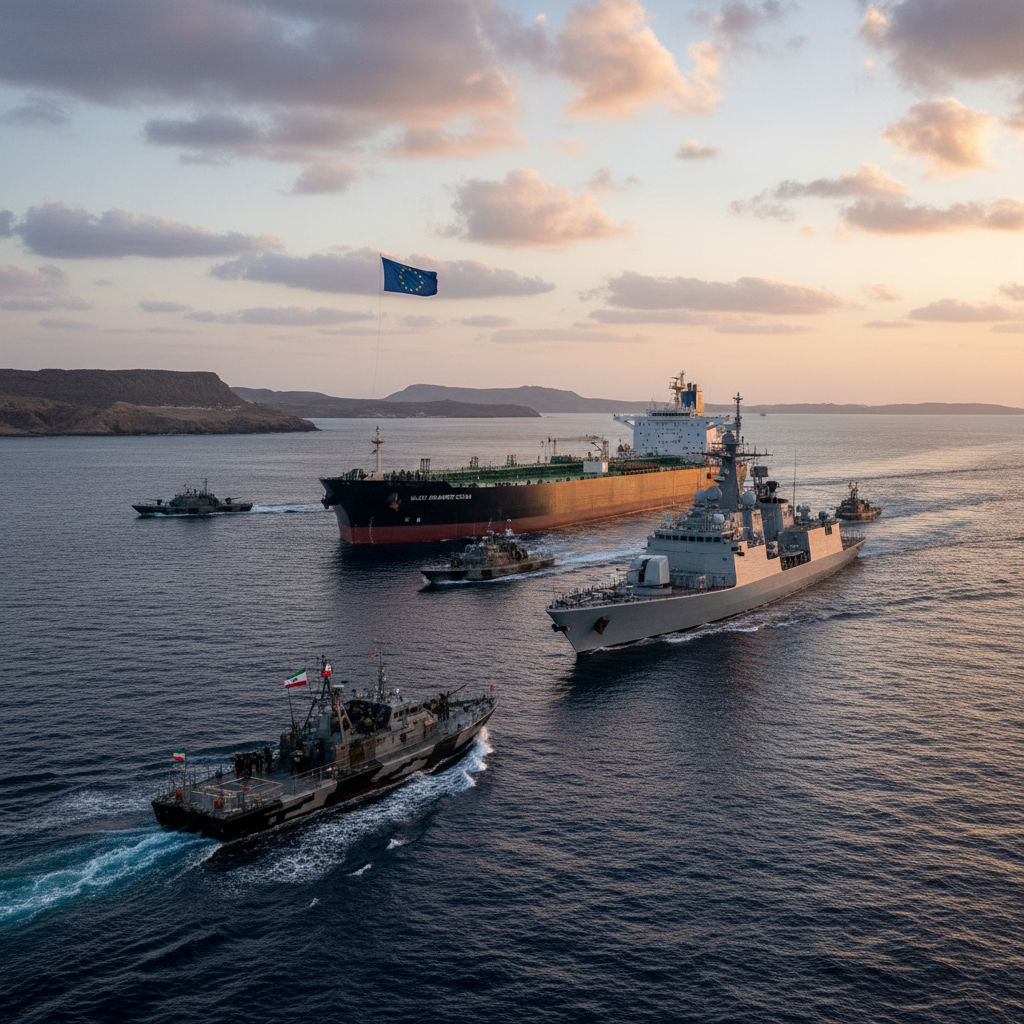
|Iran has reimposed a strict control over the Strait of Hormuz, just a day after announcing its reopening. This measure directly responds to the US blockade maintained against Iranian ports, according to official statements from Tehran. The announcement, made this Saturday, highlights the volatility in this key maritime route for global crude oil trade.
Context of the Iranian decision
The strict control implies rigorous inspections of ships passing through the strait, a zone through which passes nearly 20% of the world’s oil, around 21 million barrels per day according to data from the International Energy Agency in 2025. Historically, Iran has used this route to pressure in moments of tension, such as in 2019 when it captured foreign oil tankers.
Economic and geopolitical impact of the strict control
Background of tensions
Since the imposition of US sanctions in 2018, under the Trump administration, Iran has alternated partial closures and reopenings in the Strait of Hormuz. UN experts warn that a total closure could raise oil prices by up to 30%, affecting dependent economies like the Dominican Republic, which imports 90% of its fuel. In 2023, a similar incident sparked a 50% increase in maritime freight.
- Crude oil volume: 21 million barrels/day (EIA, 2025).
- Affected countries: China, India, Japan, and Europe receive the bulk of the supply.
- US response: Increase in naval patrols in the Persian Gulf.
Official statements and reactions
Iranian authorities claim: ‘The strict control guarantees our sovereignty against external aggression.’
The US Department of State describes the move as ‘provocative’, while the European Union urges dialogue. Analysts like those from the Council on Foreign Relations highlight that this strict control could escalate to direct confrontations, recalling the 2019 attack on ships involving Iran.
In the Dominican Republic, the Ministry of Industry and Commerce monitors local fuel prices, as interruptions in Ormuz have raised costs by 15% in previous episodes. This strict control not only strains bilateral relations but also redefines global energy dynamics.
The strict control in the Strait of Hormuz persists as a strategic tool, with Iran defending its position against external pressures. We monitor developments to inform precise impacts on the Caribbean region.