









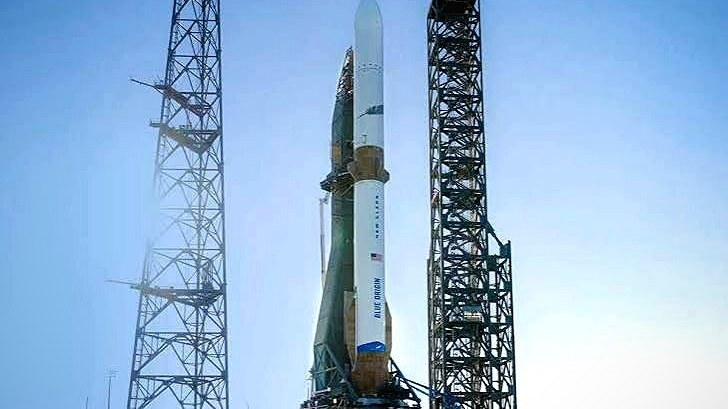
The space airline Blue Origin, founded by Jeff Bezos, announced on Friday an expansion of $330 million dollars in its Rocket Park complex, located in Cape Canaveral, Florida. The goal is to be able to launch the heavy New Glenn rocket on multiple weekly flights before the end of the decade.
Greater capacity and efficiency
The expansion includes the construction of two additional launch and landing pads. According to Blue Origin’s senior vice president of operations, Ian Richardson, the investment focuses on increasing capacity to support more missions reliably and efficiently. The complex, which already spans more than 20 sites in Brevard and Orange counties and employs over 5 000 staff, will be able to produce up to 150 upper stages of the New Glenn per year and, in the future, support multiple weekly flights.
Competition and growing demand
Blue Origin aims to compete with Elon Musk’s Space X in the commercial and government markets. The company has raised $10 billion in its first external financing round, valuing it at $140 billion, according to The Wall Street Journal. Additionally, it is working to have the New Glenn back in operation by the end of 2026, after the rocket explosion last May.
Integration center and new partnerships
As part of the upgrade, Blue Origin is building a new customer integration center with the U.S. Space Force at the Cape Canaveral Space Station. This center will enable “preparing multiple missions at once” when fully operational, Richardson explained.
Space sector context
The space industry faces a shortage of launch capacity. Space X has stopped offering commercial flights with its Falcon 9 to prioritize Starship, which has spurred massive investments. A report from venture‑capital firm Space Capital revealed that $92.5 billion was invested in the commercial sector during the first three quarters of 2026.
Impact on the satellite market
Both Blue Origin and Space X operate satellite internet services and are launch partners of Amazon, which is deploying its full Leo satellite constellation in low‑Earth orbit. Space X’s Starlink dominates the market with more than 11 000 satellites in orbit.
Source credits: deultimominuto.com
Note generated automatically from the sources cited in the text. Found an error? Email us at [email protected] and we'll fix it.