








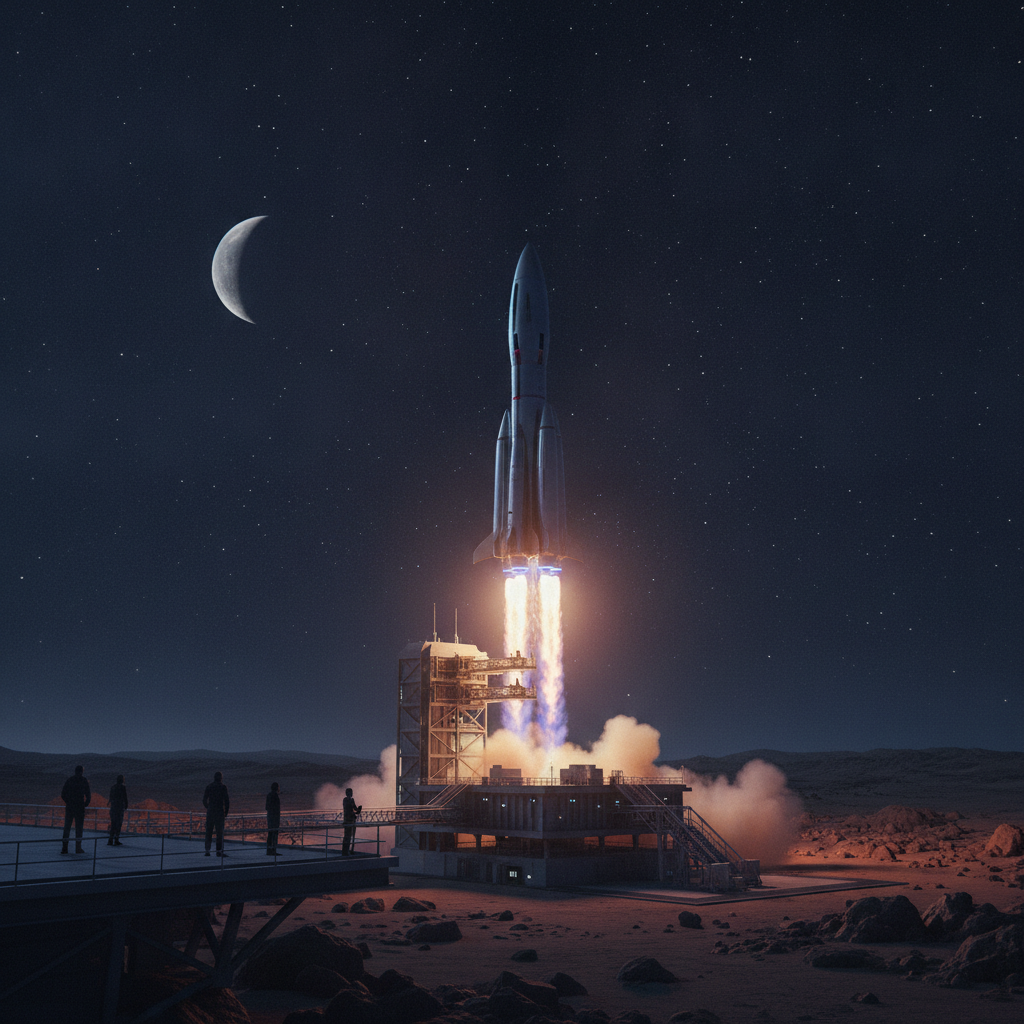
Africa prepares for its first Moon mission in 2029 with the Africa2Moon project, an initiative that will mark a turning point in lunar exploration and the scientific development of the African continent. This mission seeks to deploy the first African radio astronomy network on the Moon’s surface and position Africa as a relevant player in the new space race.
The Africa2Moon project is led by the African Space Development Foundation, in coordination with universities and research centers across several African countries. According to preliminary plans, the mission is designed to reach Earth’s satellite in 2029, capitalizing on the global momentum of programs like the United States’ Artemis and the growing space capabilities of emerging powers.
The core proposal is to install a network of radio astronomy instruments on the far side or low-interference areas of the Moon, where radio signals from the universe are received with less noise generated by human activity. For Africa, this infrastructure will mean direct access to high-level scientific data and the opportunity to collaborate on studies regarding the origin of the cosmos, gravitational waves, and extreme deep-space phenomena.
Lunar exploration and African science in a new stage
The fact that Africa prepares for its first Moon mission is not an isolated event. Over the past decade, countries like South Africa, Nigeria, Egypt, and Rwanda have invested in observation satellites, telecommunications, and talent training in aerospace engineering. Radio astronomy already has a tradition on the continent, with projects like the Square Kilometre Array (SKA), one of the largest radio telescopes in the world, of which South Africa is a key partner.
The experience accumulated in ground infrastructure and data analysis makes it easier for Africa2Moon to build upon existing capabilities and take them to a new scenario: the lunar surface. Space policy experts emphasize that participating in missions of this caliber reduces technological dependence, drives local innovation, and opens doors to new industries linked to the space economy.
African radio astronomy network on the Moon
The deployment of the first African radio astronomy network on the Moon will allow the continent’s scientists to observe frequencies that are difficult to study from Earth due to radio interference and weather. The instruments are expected to integrate into global observation networks, sharing data with space agencies and research centers from other continents.
Engineers involved in the design phase have explained in specialized forums that the mission could include autonomous robotic modules capable of positioning antennas and scientific equipment. The goal is to ensure long-term operations, powered by solar energy and secure communication systems with stations in Africa.
International cooperation and opportunities for young Africans
The fact that Africa prepares for its first Moon mission also has an educational and social dimension. The African Space Development Foundation has promoted programs to involve high school and university students in experiment design, analysis software, and data science projects linked to Africa2Moon.
- Training in aerospace engineering and astrophysics.
- Access to international research networks.
- Participation in real lunar exploration missions.
This approach aims to ensure the mission is not only a technical achievement, but also a catalyst for the next generation of African scientists and technologists.
Africa prepares for its first Moon mission and redefines the space race
Space geopolitics specialists agree that when Africa prepares for its first Moon mission with Africa2Moon, it sends a clear signal: space exploration is no longer exclusive to a few traditional powers. African participation broadens the diversity of actors, scientific perspectives, and research priorities, which can translate into more balanced and collaborative advancements.
With Africa2Moon, the region reinforces its presence in lunar exploration and positions itself to take advantage of the technological and economic opportunities associated with space. In this scenario, the fact that Africa prepares for its first Moon mission in 2029 becomes a symbolic and strategic milestone for the continent and for global science.